I approached this project still unsure which topic might work for a series of five paintings. I felt uncomfortable because over the course of part 5, I hadn’t been able to decide on anything particular. Though I had enjoyed the experimental aspects in the projects, finding a topic had always been complicated. Indeed, I seemed to get along best if there was no neatly defined subject at all and I could simply play with visual effects, for example when I experimented with wax resist.
A recurrent subject are flowers, but somehow I did not feel like developing a series from them. Landscape would have interested me most, but there was the problem of organizing my spare free time and being lucky with the weather. I was also not overly confident about my landscape painting skills.
But I had enrolled to a life drawing class starting in October and this turned out to be so interesting that I wanted to base project 4 and the final assignment on the subject of ‘figure’.
Preparatory work
Approaching the figure subject and first experiments
In the first life drawing session, there was a female model and we were instructed to draw short poses (5 minutes). This was my first life drawing class ever in my life and the time restriction made me choose an approach that was very fast, using the flat side of my charcoal piece to capture the main traits of the pose, without details. The drawings were made on 18×24 inch newsprint, which is approximately A2 size.
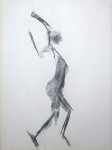
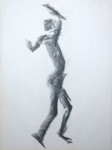

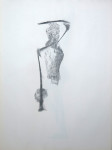
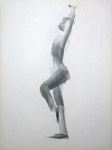
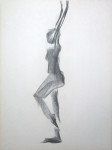
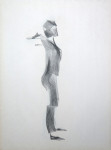
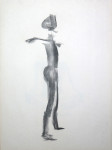
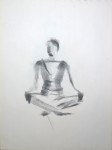
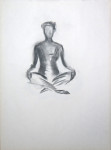
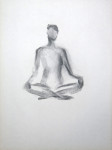
This session inspired my first experiments with the subject and technique. I liked the energy that was conveyed by the broad charcoal marks. I had not used charcoal with watercolours so far because I thought the charcoal would smudge and produce a mess when it comes into contact with water. So I used charcoal first, then spray fixed it, and applied watercolour washes afterwards.


These were made in the A3 sketchbook. From the first sheet, I particularly liked the flower shape and how it was based on a play with figure/ground in tone, and I explored this idea further in a second sheet. I liked the bold forms and the strong colour contrast between the dark green background and the soft, fleshy orange of the flowers. It reminded me of Andy Warhol’s screenprints and I made a mental note to rmyself, to research this artist later.
 Fascinated by the visual effect of watercolour over charcoal, I made a self portrait (A3 format). But I felt that I was struggling with resemblance and all the effort resulted in a somewhat overworked drawing.
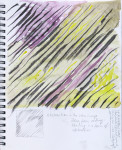
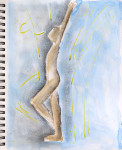
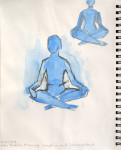
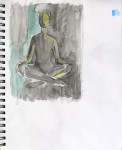
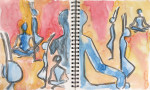
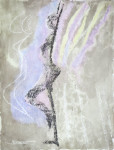
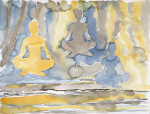
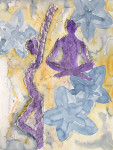
Then I went ahead and worked from selected sketches of the life drawing class to incorporate elements of the figure into a painting. I started with a standing pose and then proceeded to the seated pose, and finally incorporated several poses into a single painting. I used sketchbooks of different sizes and loose watercolour sheets for these experiments with technique, colour and composition. I liked the ideas I was developing, but found it difficult to have only my own sketches to work from, and not a real model.
Trying to develop a focal point – the male figure
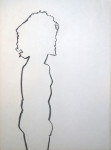
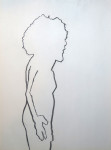
A week later, there was a male model in the life drawing class and we were instructed to do line drawings, initially blind (hence the distortion) and then increasingly “peeking” on the subject to make the representation more accurate. The final task was to make a rendering of an interesting section of the body. I chose the arm and elbow because of an interesting pattern of shadow and light. I had to spray with me and by the time I arrived at home, the drawing had been almost erased, so I reworked that one from memory, then spray fixed it.


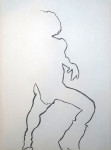
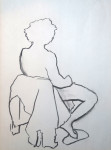
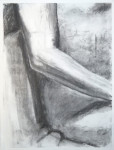
I made attempts to develop ideas from these sketches for the watercolour project, but copying my own drawings for the purpose wasn’t interesting and I felt dried out again without a model. Despite feeling engaged with my figure subject, I did not know how I might develop the idea into a concept that would work for a series of five paintings.


Clothed figure and working from photos
Addressing the problem of model availability, I found a drop-in drawing class with clothed models and attended. This class had a single pose for 2 hours with breaks every 20 minutes so the model could stretch. I saw no immediate connection to my idea for the assignment, but nevertheless enjoyed the session and the possibility to explore one pose more fully.
I made a charcoal drawing of the upper body, a pencil drawing of the head (here shown in full and close up), and a final coloured oil pastel drawing, all on 18 x 24 inches paper format. I liked the pencil drawing and felt that I had captured something of the model’s personality – a somewhat rebellious attitude, I think.


 At home, I made an A3 watercolour sketch from my drawings (the one with the red background), but this felt rather pointless, without the model present and nothing particular I wanted to express.
Since the classes where a model was available were only once a week and I wanted to get on with the project, I began searching for online resources that I might use to practice skills and continue working on ideas for the subject. I finally chose 4 black & white nude photographs, two male and two female, for further work.
Starting with the male models, I made a few charcoal sketches of the full figures, head and parts of the torso, focusing on the volume of shapes and accurate representation. I also made a watercolour tonal sketch.


Full figure rendering and final subject choice
The next life drawing class was with the previous male model again, a single pose and the instruction to make a fully worked out rendering of the entire figure. This time I started by making a layer of charcoal on the paper for a medium starting tone, and worked out the figure from that using eraser and chamois cloth for lights and more charcoal for darker tones. The practice from photos came in handy and despite some struggles with getting proportions right and finding the paper size (18×24 inches too small), I like the result overall.

From this, I developed a concept for the final series. Starting with a similar idea and using the photo of a female model, I stopped the first drawing at a point where I felt I should leave it as open and unfinished as it was. I knew that I could continue and obtain a worked out drawing of the figure, but I liked the unfinished state because it kind of captures the elements of my process: How I had started with laying the background, then drawn in the main outlines quite roughly, and then begun to work out the shapes and give them volume. I also liked that it was the bust and not the face which was worked out because it was a breach of the convention in classical drawing and reflected what I had unadvertedly/unconcsciously perceived as the most relevant aspect of the image.

I continued with an new sheet, same technique, and completed a fully worked out drawing. I felt ready to approach the final series of five paintings with this subject.
